Wedding Reception
In Colorado mountains
Bull elk gate crashes
Dancing in full swing
Enjoyment and fun
Sudden dash to the window
Cameras flashing
Bull elk wants to join us
Who can get the best picture?
We all knew there was danger
But he stayed where he was
He did not move
Posed for photos
Stayed for entertainment
The homework set by Angela for the session on 5 July was to consider carefully this speech from The Tempest
‘Our revels now are ended’
Our revels now are ended. These our actors,
As I foretold you, were all spirits and
Are melted into air, into thin air;
And, like the baseless fabric of this vision,
The cloud-capp’d towers, the gorgeous palaces,
The solemn temples, the great globe itself,
Yes, all which it inherit, shall dissolve
And, like this insubstantial pageant faded,
Leave not a rack behind. We are such stuff
As dreams are made on, and our little life
Is rounded with a sleep.
William Shakespeare
From The Tempest Act 4 Scene 1
See what really stands out for you from this speech. It may be one line or the moods of the whole. Make of it what you will and write a poem (max. 50 lines) or prose (max. 300 words) based on your reaction. Bring it along to share at the session on 5 July.
A summer day dawns Mist lifts from the mountain top I polish my boots
Missing Parts of Speech
Poetry and prose without adverbs and adjectives is like a summer without sun and strawberries. Their lack creates a drought for our ears and ideas which those missing parts of speech can help to take wing and fly, lifting our minds above chatter and chaff, nurturing insights into mundanity. The discipline of the sadhu on a ledge suits such a being but the potential in language for rhythm, scansion and rhyme are tools to be honed and cherished like a burning glass igniting fires in our hearts and minds that can then take us beyond the shadows in the cave.
The light has come back
Lambs are in the field where
Flowers paint the grass
It is that time of year. We are treated to more sunlight and the days are growing longer. Snowdrops in the garden remind us that things are changing. Leaves return to the hedgerows and to the trees. We rejoice at the colours of the flowers and go for walks in the sun by the Lake. Soon the bluebells will be with us. We rejoice with our friends the birds who sing in the trees.
A shape, etched
For future fingers yet to trace
Hunched and wall eyed
I meet your gaze
A flickering moment
and then –
I’m gone.
A turncoat self
I march along
to any song that please my ear.
A frozen statue in a forest glade –
Or assassin lurking in the shade?
Houdini-like I come and go,
A cameo part I play.
But always, still, unseen
My razor tongue, held in,
Darts
Catches, flicks around your words
And pulls them deep within.
I taste your thoughts upon my tongue:
A self dissolved
to essence.
Unsure of where my margins lie
I
Know only that
In my fishy depths strange energies
Pulse,
Tossing me hither and thither.
And yet,
The storms that make me heave and writhe
Pull my tears into the sky
To fall as dew on a rose’s bloom
Or rain on forest canopies.
I, passive,
Am filled by others’ lives
Their stories flowing into my depths
Until
Tranquil now, a mirror, I
Reflect the stars and sun and moon
And, yes, your face.
I cast myself in arching bows
A dove of peace upon my breast.
Write Haiku and either a poem, or a 200 word prose poem to expand upon the theme of the Haiku with no use of adverbs (preferably) or adjectives. The work will evoke one of the four seasons.
What an enormous privilege it was to be invited to capture some images of a vibrant and wonderfully ‘alive’ book launch for Julie Carter’s RunningThe Red Line on 21 April at The Skiddaw Hotel, Keswick. Broadband users, please click on the image above for a photobook (pdf) which will download in around 30 seconds. Best viewed full screen.
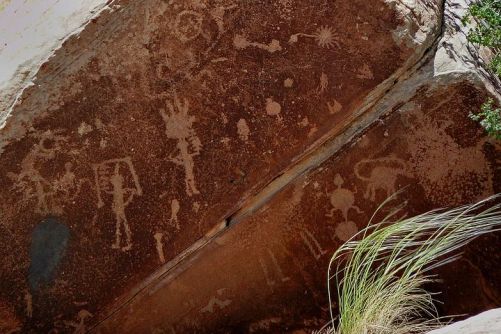
Find out about cave painting, and what it is, and how it relates to your work. Had you been alive before the days of words what would you paint (upon the back walls of your deep, dark, mysterious cave). Your painting might never be found so you can be honest and straightforward. It’s a journey for you, and for any who may find what you leave there. What will you write-without-writing to speak of your soul?
This, the new book my children gave me,
its pages empty, except for lines.
Lines I do not want, they proscribe me, hold me in.
They wouldn’t know, when they chose it for its cover –
pink, with flowers, how mothers ought to be,
that each new book I have to buy has empty pages,
unlined. Hard to find. Now, in a world
where everyone should write and stand
in line, straight side to side, not up and down,
not in the circle, nor ragged, no dots nor clumps of words,
no untidiness. I secretly long for order,
yet helplessly, my life spills out beyond the lines,
an effulgence, colour, books, words unread,
poems written on scraps, lost and found,
half-empty cups of words, littering my days.
Until I drown in things, duty, worries, memory –
the unlined pages of my life. I reject the book with lines,
yet long for tidiness. Perhaps after all, they chose wisely,
my children, seeking to help me make sense of my unlined,
unruled world.
1 – Write something themed around the villages beneath Blencathra, poetry or prose. 200 words. Can you link it into your experience with Mungrisdale Writers?
2 – Make 2 lists of things you remember about your maternal / paternal grandparents. Then circle something in one of the lists that especially stands out. Write a paragraph to explain why.
Genes, genomes, DNA in a lovely spiral,
And inside a soul stands proud,
Creates meaning as, like the prongs of a tuning fork,
I quiver into existence,
Excite the air around me at
My own frequency.
I try to bring you closer
To my wavelength, by scratching
Symbols on a page, a piece of bark, a cave wall,
I put a foot through the ice on the top of a puddle
Just to show you that I’m here.
All of my security is found
in the predictable ticking of the planet
As it spins reliably upon its axis and measures out the hours,
My soul responds with a sigh of recognition
To the same indicators
That chug around and pull into the station
Every year, more or less on time.
So don’t give me a balmy Christmas day,
Or a cold shower in July,
I have watched these days go by
And my heart pumped with the waning of the moon
And soared in my veins as the rays of a hot noon sun
Fall, and bake me into the ground.
Give me life, death, renewal,
Give me spring’s early wakeup call, or winter’s death.
Give me gold in autumn, give me responsive, bitter, living,
In all its fashions.
But never give me snow in Easter,
I will not have it.
We who are water know
familial communion with
pond and river
lake and ocean
and we abide and communicate
by way of ripple and reflection
warmed by amniotic held
flotation – raised from
which our primal gasp and
cry signalled alpha and omega
of incarnate gradation – and
sight of mothered Wisdom
and taste of liquid nutrition
alongside growth spurt’s
sensation
Yes: our infancy born from
someone else’s depths never
leaves us – we are forever
embraced by it and so return
to reflection and histories
and promise as though to the
breast – and in gazing into
layered depths see at the
same time the light of height
yes: we who are water know
familial communion with
pond and river
lake and ocean
and we abide through all
eternity
Children searching for tadpoles in the pond
Little lambs prancing in the fields
Their mothers watching and protecting
Days getting longer
Darkness receding
Light returning
Pretty flowers emerging
Trees greening
Shoots springing from the soil
I love this time of year
There is so much to look forward to
Woodland floors spreading with bluebells
Daffodils, primroses
Summer holidays, warmer weather
Fewer clothes needed
Blossoms, azaleas and rhododendrons
A time of plenty and lots of birdsong
In April the snow on the high peaks of the Lefka Ori mountains in western Crete is usually receding as warmer weather arrives. This snow is often stained a pale reddish brown from the wind blown dust of the Libyan Sahara. The locals still refer to these dusty winds as Gaddafi’s breath. Omalos is a small farming community on a 1500metre high, flat, fertile plain midway between Chania on the north coast and Chora Sfakion on the south. Apple trees delineate the small fields of wheat, potatoes and okra. Small round stone houses called mitata are used for making the local graviera cheese and also a softer creamy version of feta. Rickety fences protect the crops from flocks of sheep and goats which roam freely. It is because of the protection afforded by these fences that so many of Crete’s profuse wild flowers are found at the edges of these crops.
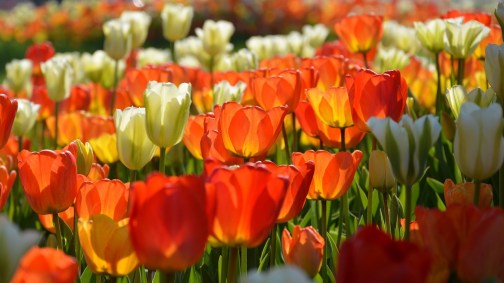
Crete is a botanist’s dream, especially in April, with around two thousand flowering plant species. Many of the plants are spiky such as spiny burnet and others are poisonous such as sea squill and oleander and these the sheep and goats avoid. Many other plants grow on the steep limestone screes and cliffs and their inaccessibility affords protection. By looking carefully around some of the field edges of the Omalos plain you will almost certainly encounter one of the five species of wild tulip to be found on Crete. It is here that you may find clumps of the endemic wild variety called tulipa bakeri. About half the size of the shop bought varieties we are used to they are a pinky lilac shade with delicate pointed petals. In the strong breezes they dance around with a natural gestural eloquence that all tulips possess.
Where to start
My love is life itself
Favourite loves change with age
More gentle past times play a part
Music, sailing , oceans and rivers
Still stir my heart
Family – the bond of love ever strong
Grandchildren on the cusp of life
What will their future bring
I want to know but cannot
Contented now
Log fires, red wine and friends
I’m more claptrap than Von Trapp so
Let’s rap
What do I love? You really wanna know?
Well here’s a list and here I go
I love the tricks that light can play
How it chases the night and colours the day
And that’s kinda cool, no colour no hope
So I wanta live in kaleidoscope-scope
Pick up a brush and paint for joy
Just joy
No ulterior motive, no sinister ploy –
Just joy
And hey, Mr Bach, now he’s my man
He makes a tune like no one else can
And on that cello
he’s soaring and mell-ow
He’s on in my car where I feel at ease
To come and go just as I please
Now smell those hyacinths and look at those trees
In their greens and browns
And their red autumn gowns
Sliding cool into black for the snow to scarve
As it covers the world in waves of white
But most of all I love just this
The Black and white of the written word
That gives me wings to soar like a bird
And draw a picture for you to see
What I love
Cos you are my literary fam-ily
1 – Following our conversation about this year’s Mirehouse Poetry Prize winners (winning poems here) – think about the poem you chose as your favourite and write one of your own (poem or prose poem) along the same lines. 200 words maximum
2 – Allan Jenkins’ Morning (his Plot 29 was also mentioned) reflects on what he values about mornings. Write a few lines about your own appreciation of morning, or evening
3 – Think about your use or non-use of punctuation in some of your recent poetry
Angela Locke has run writing retreats on Iona for 20 years, a place that offers powerful inspiration. For Ian Hall it was the sale of Thorneythwaite Farm in Borrowdale, his childhood home, that prompted his extensive research into the farmstead’s 1,000-year history. They discuss how writing can be animated by a sense of place.
Thorneythwaite Farm, Borrowdale (Orchard House Books) & Whale Language: Songs of Iona (Indigo Dreams Publishing)
Write a non-fiction Nature Column in 300 words. This will involve your powers of observation over a period of time. It might prove to be a bit philosophical, and / or reflective / meditative, or simply observed fact. Use of your personal life-experience might call upon work-related experiences and so on.
The book The Long View (Somewhere-nowhere Press) was mentioned as a resource and inspiration. From the programme for Words by the Water, Tuesday 13 March at 4pm (£9)
What do trees witness? What do they mean to us? What is being done to protect them and increase tree cover? Writer Harriet Fraser and photographer Rob Fraser visited seven ordinary trees in extraordinary Cumbrian locations over two years in all weathers, night and day in the company of school children, ecologists, land managers and tree specialists.
Julie Carter is a hugely valued member of Mungrisdale Writers. Julie’s friends will be thrilled with the array of book recommendations to be found on the back cover of Running The Red Line, the front cover of which presents an outstandingly evocative painting by Vincent Alexander Booth. But the reflection that most rang bells with me is that from Professor Peter Wright, a psychologist from the University of Newcastle:
An extraordinary book in which the author takes you on a journey during which she offers you so much of herself that you feel at once privileged and grateful to be invited along.
This is the Julie Carter – doctor, psychologist and champion fell-runner – we know at Mungrisdale Writers, someone whose life and writing ‘offers you so much of herself …’
Saturday 21 April, 8pm, The Skiddaw Hotel in Keswick. This is a book I’ll be first in the queue for. I too feel ‘privileged and grateful to be invited along.’
Thinking about one of the glorious Writing Retreats on Iona this year? Needing a bit of encouragement to get on and book it? (links to brochures and booking forms below). OK. Here’s a little bit of photographic and audio-poetic encouragement (aka – the nudge you may need): please click here
Mr Feis has a kid at home, where he’s dad,
But he was at school then, when
He was with his other children.
He put his body between those children and a gun,
The last thing he could do,
To do his job.
The last thing he would ever do.
He stepped forward, arms outstretched,
Because sometimes the heart acts,
Before the head has time to think.
In his home there is now, a vacancy,
In another place,
There will be a welcome cry.
We always took a short cut to school. We found that by climbing a wall, then scrambling across the corner of a garden to a second wall we could then climb onto that wall and then jump down into the school grounds. This cut quite a large corner off our walk. This adventure was usually punctuated by a little old lady, the owner of the wall and garden, who used to come out and shake her stick at us and shout loudly. Her dog always barked vigorously. But they never caught anyone. We were too quick for that.
Some years later when my mother came home one day she asked if I would be very kind and take a little dog Sammy for walks after school every day. His owner. Miss Pilgrim, was now too old to take the dog out I wasn’t sure. I didn’t really like taking our own dog, Mac, for walks. He was quite old now and although still very lovable he was very slow. But eventually I agreed. I was somewhat shocked when I discovered that Miss Pilgrim was the owner of the wall and garden we had climbed over and the dog was the one who had barked at us so much. I soon became very fond of Sammy and also of the old lady. Miss Pilgrim. I didn’t know whether she remembered our antics on the wall, but she was always extremely nice. Every day after school I took Sammy for his walk and then had a chat with Miss Pilgrim. She always seemed to appreciate my opinions and we got on very well. She treated me as an equal, as if I was an adult. She also gave me little presents like sweets or chocolates, which I wasn’t allowed at home because my mum said I was getting too fat. When Christmas came mum gave me a present to give her. I can’t really remember what I gave her but it was probably some soap and talcum powder, which was very popular in those days. I remember how pleased she was when I gave it to her. I expect she had other visitors but I never saw anyone else in the house. She gave me a book for Christmas. I still have it somewhere. I loved her and her dog. I suppose they were my first loves outside my own family. Taking Sammy for a walk was great fun. He could walk or run as fast as I could. He didn’t seem to get tired if we went a long way. At weekends I often took him across the fields. I enjoyed his company very much.
We went away for Christmas that year. When we arrived back I insisted on running round to Miss Pilgrim’s house. The plan was that I would take Sammy for his walk and thank her for her present. The house looked different when I got there. Something was wrong, Sammy was not barking. What had happened? A strange lady opened the door when I knocked. “Miss Pilgrim is dead”. She said. I was devastated. I ran home to tell my mother. She went round to the house to find out what had happened. Miss Pilgrim had died suddenly the day after I had seen her last She had a heart condition. I was heart broken and cried for ages. The lady was her niece who lived on a farm in Essex. Sammy was taken to Essex. Mum said we could visit him, when we went to see Uncle Maurice and Auntie Ethel who lived down there. We never did. The niece told Mum how grateful the family was that I took the dog out regularly and visited her aunt. I was thanked for being so loyal and going daily to take the dog out. I was upset about Miss Pilgrim’s death for a long time because it seemed like something very important and special had gone from my life.
It’s that time of night when fear grows tumours. But it’s also when I find a mental clarity which often eludes me these days.
Before I woke I dreamt of the day we met. Once again I saw you, walking towards me through the mist, your face, unaware of watching eyes, wrapped in a dream. And just as it had all those years ago, the veil of your hair, dew-laden, shimmered as if with a thousand tiny pearls. As soon as I saw you, Mol, I swear – the minute I clapped eyes on you – I said to myself: That’s my girl; that’s my girl.
My heart was racing when I woke and there was an ache I’ve not felt for years.
So here I am, writing a letter I won’t send like an old fool. What happened, Mol? What went wrong between us? We were great at first, you can’t deny that. Those early days, when the bed was our universe, was that love?
Having written the word ‘love’, suddenly I’m not sure what it means. I read somewhere that Eskimos have over fifty words for ‘snow.’ If that’s true then ‘snow’ becomes a generality, the heading to a category, like ‘plant’ or ‘animal.’
Maybe ‘love’ is the same.
I’ve got down the thesaurus you got me that Christmas because you were sick of me saying that everything was ‘great.’
Here are some words for love: attraction, desire, passion, adoration. And yes, in those early days we ticked all those boxes. But what about later?
There are other words in that old thesaurus: affection, kindness, friendship, treasure.
It seems to me, Mol, that friendship and affection somehow got lost along the way. How did that happen? Was it laziness? I think on my part it was stupidity. I guess I thought that as we were a couple it was job sorted. I kind of stopped seeing you, if you know what I mean. You were just a necessary presence in my life, like air or water.
I know now you tried to pull me back. ‘Listen to me! Why don’t you LISTEN to me!’ God, how many times did you yell that at me? But why did I need to listen to what I’d already heard a thousand times or about something that didn’t interest me?
That’s the problem, I switched off sight and sound so what was left?
I’ve just thought of Dante’s Inferno. Didn’t he have different levels of Hell? Well maybe there are different levels of love and if you don’t move from one to another you get stuck in a groove until it becomes unbearable. Once kindness, affection and friendship have been worn out there’s nothing left but indifference and ritual.
I’ve heard that you met someone else and are doing just fine. I’m glad, you deserve it. I met someone too and, yes, I’m very happy. Because I learnt my lesson, Mol, I’ve moved to the next level, to the treasure at the heart’s core.
It rained.
It rained again.
And then it rained some more.
The wind came howling from the West.
Waves pounding at the shore.
Spring tides, the highest of the year
combined with non-stop gales
destroyed the pier and breakwater
like matchwood swept away,
and along with them my memories
of summer nights upon that beach.
We were what is known as sweet sixteen,
heads full of foolish dreams.
We held each other in the dark
and whispered silly things
like we would not be parted.
We didn’t even last through Spring.
I carved for you a Cupid’s heart
on that breakwater’s underbelly,
just to find when you were gone
I was only one of many.
I put blisters on my hands for you
when I did that breakwater carving,
oh how I cheered above the storm
as I watched the timbers parting.
Make two columns: in the first, write a list of at least ten things that you love – things rather than people. In the second, write something more specific: eg Library | Mary Oliver or Garden | Weeping Willow.
Then turn the columns into a little piece of writing, poetry, prose or … song!
In the month of Valentine Angela’s homework for our next meeting on 22 February is to write up to a page about ‘Love.’ It can be a short play, prose or poetry about love. Angela said she would prefer it to be about romantic love although it could be ironic or about sibling love. Angela cited Shakespeare’s Sonnets on love as being good examples which are particularly ironic about love.
The homework set at the last meeting on the 23rd November was to do a blog entry.
Imagine you have a blog and create a blog piece about anything you want. Aim for ‘divine creativeness’. It could be something from your day or a recent event or just a random idea you want to share on your blog. Limit it to 200 words. Have it ready for the first meeting of 2018 on the 11th January.
To help you with this look at Kathleen Jones’ ‘A Writer’s Life‘ blog
The next meeting on the 14th December is a Read and Share starting at the normal time. It will finish a little early for the Christmas lunch at the Horse and Farrier, Threlkeld.
An amazing session today. Thank you all of you who braved the weather to be there, though we did have some diminution in numbers because of the weather forecast. We explored the nature of writing, and where Art ends and technique/skill begins. The powerful tool of stream of consciousness writing produced some fantastic work, really inspiring from everyone. This is the raw material from which you will extract your refined product! I was conscious of how much good writing there is in this group – real talent, and so wonderful to listen to and explore, all memorable.
Colin Dixon will kindly send you homework, and although this is my last session this year I will see you, of course, after your Read and Share session in 3 weeks time, for our Christmas lunch! I’m looking forward to it very much.
There is a garden behind a wall, where hollyhocks stand straight and tall
Lavender roams wild and free, ivy wraps round every tree
Maiden fern and meadow sweet weave a carpet at your feet
Flower heads embrace, entwine, Harlequin and Columbine
There is no bird song in the air, bees and butterflies take care
If you should ever stray near there, take the time to have a look
And see the babble in the brook
One thing you will never see, is my friend Mallory and me
Mary Younger
A mandarin moon moves maleficently across the sun creating an eerie orange glow throughout the valley.
The wind sails in on a sea of white horses. Heads rearing, manes tossing, wildness of a bush fire reflected in their bulging eyes.
Trembling trees grow arms to hug and hold each other tight until the tempest passes.
In its wake a Whirling Dervish picks up its skirts, dances a fantastic fandango to the beat of the retreating horses’ hooves. During the dying throes of the dance the Dervish dips its head into its heart, diminishing in the dust.
The quietude of evening post rush hour throng
The lull before a storm, a hushed dirty sky
The silence in a church when the choir stops its song
The parched empty bed where the river has run dry
Some stillness salves the soul
Becalms a troubled mind
The singing of the bowl
Serenity and Sound combined
Write a completely unpunctuated piece (prose or poetry) and set yourself a strict 10 minute time limit to do this in. No capitals, full stops etc. It should be a stream of consciousness writing form relating to an event or moment in your day. Something that moved you during that day. Possibly seasonal.
Then write it again with full punctuation. Keep both versions.
Chris had been really pleased when Jane telephoned and asked if she could stay with him for a week of the Easter vacation. She was doing her post graduate teaching qualification in Newcastle and they’d met six months earlier when he’d been doing his. Now he was in his probationary teaching year at Penrith’s Ullswater Boys’ School.
The early Spring sunshine through thin curtains woke Chris and he’d spent a couple of hours cleaning and tidying his rented cottage at Kitchenhill just outside Penrith. Later he met Jane’s train at Penrith station and she said she would like to see a lake. They’d driven down Ullswater, chatting easily, and carried on to Ambleside.
There they’d gone into a chintz and china tearoom owned by a striking woman of about fifty in a long dark skirt, bright green blouse, beringed fingers and dangly gold earrings. Chris noticed the earrings were sigil-like stars and crescent moons as she took their order. They also learned that her name was Mary and she’d previously owned the infamous ‘Jungle’ transport cafe on the A6 near Shap. She’d sold it three years earlier, just before the M6 had opened in 1970.
Mary had asked what they did and Jane told her. “You won’t ever teach” said Mary quietly to Jane. Jane’s brown eyes widened “Why do you say that?”
“I see things.” said Mary with a slight moue and an apologetic lift of her shoulders as she turned back to the kitchen.
Oh Gretna Green, exalted place, young love’s impetuous mistake,
Optimistic souls unite, above an anvil troth they plight,
Bagpipes loll with limbs outspread until their breath returns,
On motorway, the sun ascends, a far horizon burns,
The birds sing out, hope rises new, as glimmers of the day peep through,
Light crept above the concrete mall, wool shop, whisky shop and all.
Through golden sunrise jumped a ray,
That flash brought Jack to earth, on summer’s longest day.
Officials who logged on first thing, learned of a legal glitch,
All weddings made in Gretna had one important hitch,
Each certificate of marriage, each wedding was destroyed,
Was cancelled out, abolished, repealed and null and void.
Cumbria News cries out all day, to those that Gretna wed,
‘Technically, legally, you are not now, have never been,’ they said.
Ask yourself what you would do if put in this dilemma,
Would you marry them again, keep the same old fella?
Would husbands start again, propose, and go through the whole thing?
Would they have to book a room, a meal and buy a ring?
Gretna Green was sanctified by antiquated rules,
But now the Gretna bureaucrats were made to look like fools.
Women thought, ‘I see that I’ve been single all my life,
A mother yes, a cook, a maid, but not it seems, a wife.’
Husbands scratched their heads, they paused and listened to the news,
Weren’t married now, had never been, felt anxious and confused.
The news rolled like a clap of thunder,
‘All set free in one big blunder.’
Jack’s sabotage was done, he watched the summer haze,
He had to hitch a sunbeam ride, to grasp the dying rays,
And wait in space for his next chance, next June the 21st,
Might make another joke go far too far, might do his worst.
A good day’s work for Jack the yearly, Jack the naughty, Jack the nearly.
Some were glad and some were sad, but Jack was quite elated,
He melted back into the sun, became a flame, and waited.
Magical realism is a contradiction
The real world is wonder enough,
So why follow a path of myths?
As the sun rises,
The miracle of human birth,
Allows the understanding
Of this Earth.
Real challenges to be confronted and enjoyed.
So why hide behind mystical words?
Reach out to those
Mountains to climb
Seas to sail
Skies to fly in
Countries to roam
Peoples to meet
Celebrate our time here
Before the sun sets for the last time
Who needs fiction?
It was only sunrise giving life to every corner of the small bedroom three that brought relief to brother Ron. The angry man who threatened to strangle him never came after day break.
After only a few nights sleeping in bedroom three, Brother Ron was allowed to sleep next door at Grandmother’s. Bedroom three remained ever vacant.
The previous tenants had been the Downes family. Mr Downes, suffering from an incurable disease, was forced to spend the last months of his life confined to Bedroom Three. His isolation caused terrible fits of jealousy, convinced his wife was having endless affairs, he tried many time to strangle her from his bed.
“That’s him – that’s him” – brother Ron cried during a chance meeting with Mrs Downes and her elder son Leslie. “That’s the man who wanted to strangle me”.
Leslie was indeed the spitting image of his dead father.
When we eventually moved house, we exchanged houses with a family of three daughters. The youngest was allocated bedroom three.
Shortly after they had moved in, Grandmother heard loud screams coming from bedroom three and reports of an attempted strangling were gossiped by neighbours.
ii Magic and Magic Realism
It was mid October; the tail end of Hurricane Ophelia was ravaging Cumbria.
A mother and her two infant children peered out from the safety of their bedroom, witnessing the frightening effects of natures force. Leaves, branches, twigs swirled helplessly and garden furniture cruelly dumped from terrace to lawn.
“Our tree house won’t be blown away will it mommy?” the little one said.
In the light of daybreak, after Ophelia had blasted goodbye, the young mother surveyed the scene, anxiously viewing the tree house. It was very much intact, but its door had been blown wide open.
The outline of a burly man, silhouetted against the rear window could be seen clearly, whoever could it be. The figure was still there by the time she had dressed, she just had to go and investigate.
She climbed up to the tree house, fearful and tense, nervously calling several times after noticing that the door was now firmly closed.
Still calling, she slowly opened the door to what she thought was a rustling sound. The Tree House was empty, but for a large pile of leaves slumped on the very spot where the intruder had stood. The leaf man was obviously not for human eyes.
iii Cigam
Searching for magic and its realism, I found myself in the tiny village of Cigam, a small backward village in the heart of Cumbria, distinctive for its small buildings with pointy roofs.
Entering a building sign posted ‘Info Centre’, I was directed by arrows to a lift marked ‘Magic Beware’, which opened itself and beckoned me in. The lift walls were adorned with pictures of Broomsticks, Wands and Witches Hats, it had a distinct smell of Cordite and cat pee.
The lift floor collapsed into a chute the moment I stepped inside. Down and down I went, landing eventually on a large soft cushion emblazoned with the words “Bum Saver.”
Only one door had the sign “MAGIC” and it was through this door I heard music and dancing to a song most familiar to me, a song passed down through generations of my family.
As I slowly opened the door, the song started once again from the beginning.
My mother bought some cheese, it made my father sneeze The cat had a fit in the kitchen; the dog had the same disease The chairs began to dance, the table did the same And the beautiful picture of grandma fell out of its golden frame.
And – would you believe it? – both chairs and table danced frantically before me, only stopping at the sound of a thud when a picture fell from the wall.
We pass the Buchaille Etive Mor, that classic mountain pyramid, as we drive deep into Glen Etive to the head of the Loch. We take down the canoes and pack them with a two man tent, sleeping bags and enough food for three days. After paddling a few miles down the loch we spend the first night camped far from any roads on the loch shore. On the second day we pass under the Connell Bridge as the tide is in and paddle on to the sea. The tide is starting to turn so we quickly paddle back into the loch before the rapids under the bridge can form as they do at low water.
After camping on the loch side for a second night I awake to a glimmer of light through the tent fabric and unzip the tent door and flysheet. Still lying in my warm sleeping bag I enjoy the strengthening light. The Americans call this half hour before and after sunrise ‘the sweet light’ when luminance grows and the world forms anew. Through a light mist a little further down the shore I become aware of large forms moving quietly. In the night a dozen red deer have come down to the loch to graze. Our different worlds, for a few minutes, are shared.
With Sunset
The cooling air is clear and still
The path now knows my feet
Leading, winding
To the beach.
Calm waters reflect my lamp
Encroaching dusk protects the boat
Departing the horizon.
Delivery complete;
The black air is clear and still.
With Sunrise
Another morning.
Track and beach
Protect their secrets
Free to enjoy the on-coming day.
The warming air is clear and still.
I screeched as loud as my lungs have capacity for air! With deep joy I can smell the ocean, I know it is just beyond this brae. The pain of my harrowed feet lifts and I start to run towards the edge of my world. I lift my arms above me, fingers open, air travelling briskly between them. My shawl falls from my shoulders – I can not care! Surely I taste the salty air around my lips. Battering me with its beauty, there it is – mighty watery landscape, half light upon it. On a distant rock a lighthouse calls me forth. Rolling meadow grass left behind, I’m met with a terrain of boulders, strewn across where land meets sea. Aware of this thin boney body, that has now become mine and the burning of my mule feet. I tumble, clatter and falter, relieved when I reach the sand. I fall at the small waves and with haste and with delicacy, I remove what’s left of my shoes. Shocked by the sight, I move forward to let the water splash over my feet, cleansing them with sharp relief. My body drops into exhaustion, ready to allow stillness to come over me. With low mist snaking in and purple skies darkening, the light offered to keep sea travellers safe is my comfort as I wait.






















 With Sunset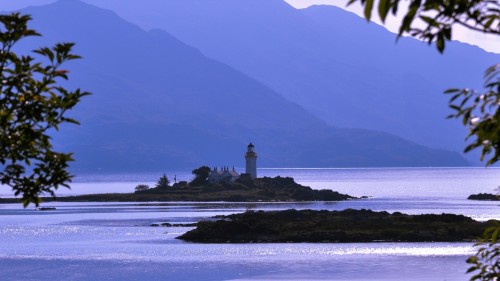
 Mungrisdale Writers
