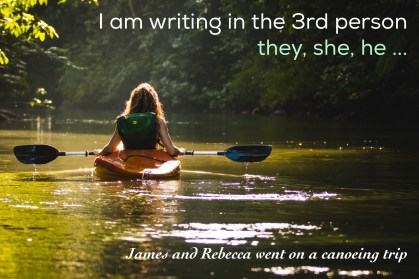
Homework:Find a couple of lines from a poem or story and continue with it yourself from the 3rd person point of view – but close third person so that you are right in the mind of the characters. This can be poetry or prose – although prose might be easier, more natural, for 3rd person.
This meeting (and Christmas Lunch) on the 8th December will be our last session until the Spring Term begins on Thursday 23rd February 2017.
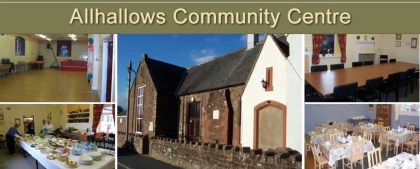
Sorry for very short notice but tonight there is a Read and Share Poetry event at Allhallows Community Centre, Fletchertown from 6-8pm
All welcome to a joint do with the Wordsworth Trust and Solway Arts. The organiser is Caroline Mckenzie, 016973 71103
Fletchertown, a former small mining settlement, full of social Cumberland history, is right by Mealsgate just off the A595.
Thanks to Caroline and a local team it has become a hub of community art, history and creative arts activity.
Brian Campbell, Melvyn Bragg’s favourite Wigton artist and a noted Solway poet, will be there and signing copies of his new poetry book Back o’ Skiddaw.
The winter comes, I feel it, without anticipation.
I know it through my settling earthbound roots.
I know not the animal dread of cold and dark.
My boughs sculptured by summer’s passage to lift my leaves sunwards.
Now I have let them drop to earth, to feed my community the soil.
The soil my home. The earth, the spinning earth.
I draw myself in and wait without anticipation, under the frosted fog.
Playing out my destiny in the eternal moment.
I am the Elder Mother, spirit made tree.
My carefully crafted medicine is of myself, for myself.
I know not the animal dread of age and death.
The vulnerable robin, the clever striving human, they come to me needing nourishment.
It pleases me to give but not to court the animal demon, greed.
They may take of me, by measure, with gratitude.
For I am the Elder Mother, spirit made tree, in cold earth, which will turn warm again.
I do love you, old Max, though now you’ll never know just how much. Danny knew, and my cousin Jack, he called me his little scorpion. ‘Underneath that carapace’ he would say, ‘lies a dark, soft centre, but sting first little scorpion and prevent being stung.’
Oh Max, your face when I told you I was pregnant. What was it? Shock? Joy? Panic? Love? Loathing? Certainly the latter when I said the baby wasn’t yours. I had to sting first you see. And then the gun was in your hand. ‘Kill me’ I screamed inside my head, ‘before this cancer devours me’.
We’re on my boat drifting far out at sea. You’ve removed the bilge cocks, the water will come in fast. Silence, then the slap of oars as you row away. Blood seeps from my body. I touch the flesh where your bullet penetrated my skin. I do love you, old Max. If I had a headstone my epitaph would be, I LOVED MAXIM.
In the last two years I have had to surround myself with a city wall of rationality. Brick by brick, it protected me as you encouraged me to hope, no matter how immeasurably slight that hope may be. And now that your medicine has failed, all you can offer me is the fairy stories of religion, with the numbing comfort of an occasional morphine hit. Now that I, by myself, have tracked down one last hope, you want to deny me the scientific, rational, logical conclusion.
I do understand that it’s a slim chance, but it’s been a slim chance all along, and I’m ready to take it if the alternative is no chance at all. Surely you, of all people, can understand that? I want to justify science, and through me, others will see that true reincarnation, true rebirth, lies in this world. I will live as a symbol of hope to mankind. Let me be the true ‘life after death’.
Entombed in my bridal chamber, Now my son’s ambition has vaulted To sting my husband’s pride. These castle walls are my prison, And I can only recollect the times, I gazed over the fields of Aquitaine. Green upon green meeting the horizon, Fish-full, viridian rivers, and verdant Forests, alive with boar and venison. With all the wealth and power it brings, I still needed a husband to protect me. I bore eight children, and your philandering. But, my fortress is within. Built of sinew And nerve to develop trade agreements, With Constantinople and the holy lands. Potent courage rode with me to the Crusades. Quick wit and intellect suffuse my bones, And my daily prayers and readings nourish My mind and marrow, and save me for tomorrow, For the days, when I shall reign again. Eleanor, By the Grace of God, Queen of England. I need neither man nor glass to witness the noble Countenance, the admired golden curls and almond eyes. I know it is the lionheart that beats beneath, The soul that dances strong and free That makes me more than beautiful.
I remember pillow fighting with my brother, with whom I shared a bed, being told by an anxious mom, not to break the wall mounted gas light mantle.
I remember swapping some old clothes for baby chickens from the handcart of a rag and bone man.
I remember mom and dad letting us keep the chickens in the back room of our terraced house, picking them up and placing them inside the hearth fender boxes when they became inconvenient.
I remember refusing to wear some of my Granny’s shoes to senior school after she had died, they were a good fit, but my pride let down my struggling mother very badly.
I remember delivering newspapers on my bike in a very strong wind which blew and turned my paper bag inside out, and I remember watching all of the newspapers wave goodbye very merrily
Alone in my Trump tower I am locked in a discourse with my own
reflection.
Conscience doth make cowards of us all.
Will it be nobler to accept the presented poisoned chalice?
Or die on my sword nobly blaming my many critics in true Trump style.
The predicament I am facing is not of my choosing,
The blame must rest firmly upon the shoulders of Hillary Clinton,
She should have won the election, my rantings designed to make it so,
Thus not causing the heartache of a thousand shocks.
I should now be happily engaged in what I am good at,
Wronging the oppressors, claiming a rigged vote, stirring up even more
discontent.
In this regard currents have turned awry.
Seven score and eleven years ago, our fathers brought forth, on this
continent, a new nation, conceived in Liberty, and dedicated to the
proposition that all men are created Un-Equal
There – I have re-written some of our great history, Trump style.
I first caught sight of you in my wing mirror
half way up the Sma’ Glen; high place, grey rock
smoothed and polished by four clean winds,
bog myrtle, sphagnum moss, bent over bushes
stunted, blunted down the years.
You were parked up in a layby,
about to get back in your old silver hatchback,
your kilt aswirl in the breeze.
Who knew we were going to the same place?
And when you stood later by the grave,
you and your fellow pipers resplendent
in black and red, the silver pins on your plaid shawls
glistening, the sharp point of Schiehallion poking the heavens behind,
I knew you’d filled your pipes with mountain air
for you blew all the wild wonder of the glen
into your pibroch lament.
Kirsty Hollings
Many congratulations to Kit who won 3rd prize at the 2016 Maryport LitFest – ‘Wild’ – for this evocative poem
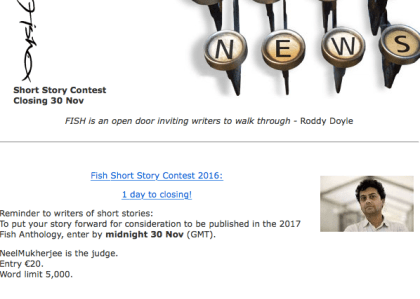
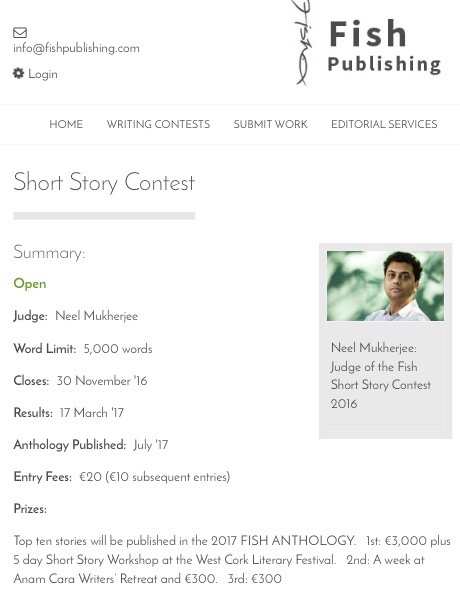
Have you time before the 30th November for a burst of enthusiasm, a glorious mad dash towards the finishing posts of a new short story? Click the screenshot for details of the Fish Short Story Competition. Think quick. Think John O’Donohue, think West Coast of Ireland. Think “I can do it”. And do it!
Snow topped Fells. Frosted fields. Winter sharpens ancient definition in glorious Lakeland scenery. And every year, noting steaming breath, I marvel at sheep knees and noses withstanding intense cold.
At the Maryport Literary Festival, hosted at the Senhouse Roman Museum where picture windows frame the Solway Firth, I enjoyed a tour de force from Steve Matthews (‘polymath and raconteur’) whose book Lap of Horror tells of early travellers to Borrowdale and Derwentwater.
The genius of the Brontë family came alive in Angela Locke’s illuminating conversation with renowned authority Juliet Barker. Each of Patrick Brontë’s children was shy. Writing became their means to articulate rich inner lives.
A personal and poignant reading by Grevel Lindop, the timbre of whose voice hums in his stanzas before he speaks, brought poetry’s moving power to search depths centre stage.
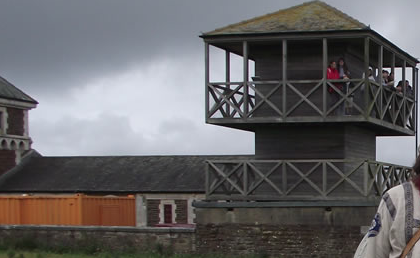
Echoes of Roman soldiers on the mileforts. Time-travel to walk with early Lakeland tourists. Encouragement to the shy. A great poet’s inspiring to aim high. Solway Firth’s sea and sky. Treasure of a way to spend a winter’s day.
Here is light behind letters that turn into words and sentences and paragraphs and chapters and stories. Expressions of my life – or of yours.
That’s why I write. That’s what brings writers back to blank pages every day – the pursuit of illumination beneath letters.
Light behind letters speaks to me of Creation herself. Darkness and light. Something of light inscribed upon dark. Something dark frames light. One does not exist without the other.
As music needs silence to sound its aliveness, so the writer paints dark upon light or light upon dark and knows that there is a knowing.
Signatureis a major resource for inspiration-hungry writers and readers. Its strapline ‘making well-read sense of the world’ invites me both to read and write well. I signed up for theirfree newsletter and received The Ultimate Guide to Writing Advice.
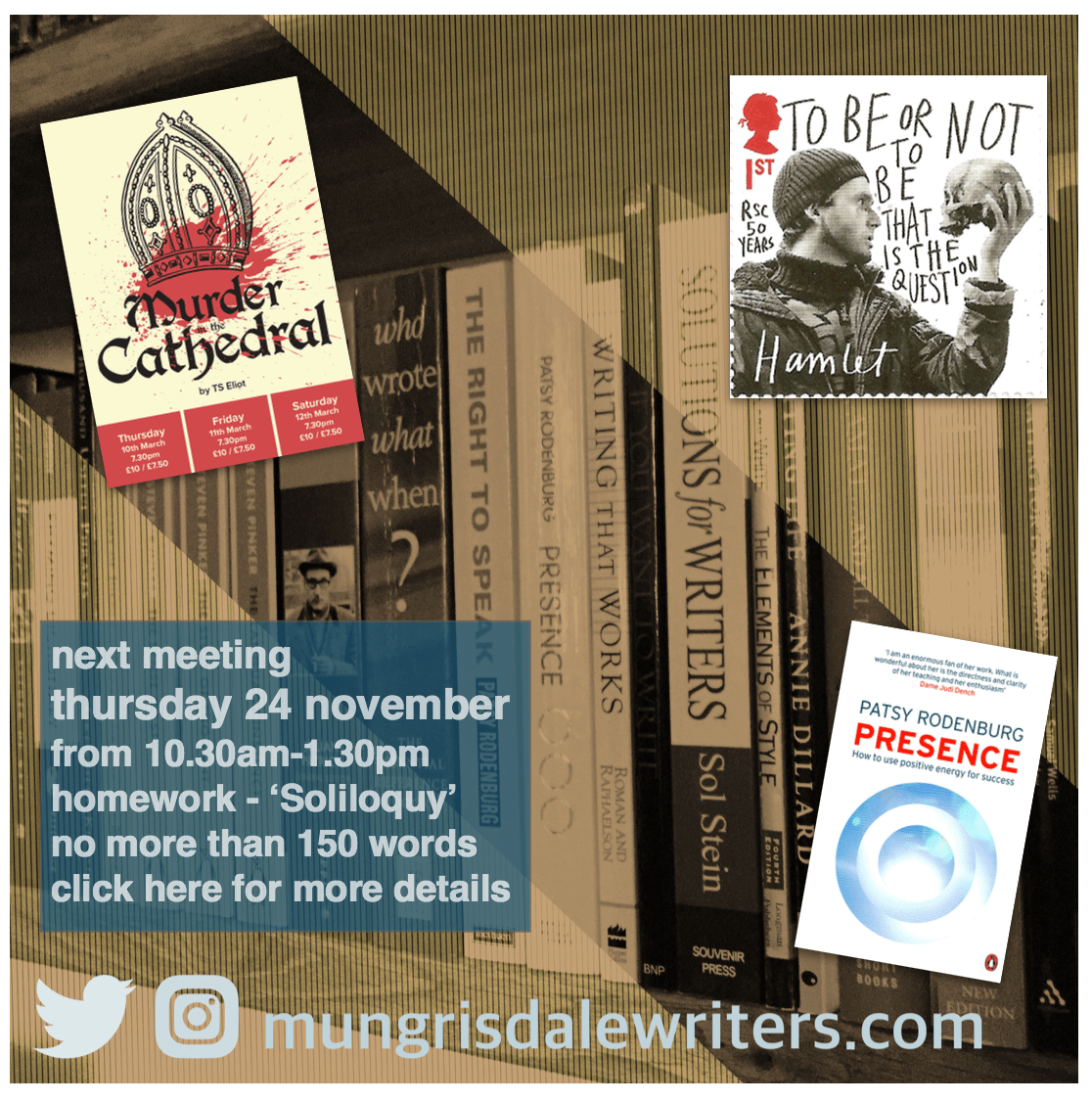
Homework:a 1st person speech (soliloquy using “I”) by someone who isn’t you but you have to research a bit (eg – a countryman or woman, a streetwalker etc). The piece can be either prose or poetry in 150 words or fewer. You might look to Hamlet’s ‘To be or not to be’ or to TS Eliot’s ‘Murder in the Cathedral’ for a bit of inspiration.
Friends, I hope you managed to catch last night’s wonderful Channel 4 programme ‘Great Canal Journeys’ – the second of two with actors Timothy West and his wife Prunella Scales. Last September we saw them both filming in the churchyard on Iona, and there was a big section about Iona, including Prunella and Timothy sitting in the Argyll! Both that programme and the one before are worth catching up on if possible, as they are both about the Highlands, and the context of Iona.
The first flakes of snow coldly kiss my cheek
Melt and are gone,
Replaced quickly again by others
But determinedly, head down, I still press on,
I know that snow is forecast
And quicken my stride up the fell.
I am checking and closing down my traps
Before the forecast wintry spell.
Three traps I am closing
While still the snow is light,
And in the grey of winter’s day
I strive to finish quickly
Before the onset of bleak night.
I am determined to complete the task
Before light fades away,
And lengthen my stride, collie by my side,
Constant as ever disregarding the weather
My ever faithful guide.
The task is simple. I reach with my stick
Put pressure on the treadle,
Give a firm push and the door swings shut
The trap is now disabled.
I repeat the procedure at each trap
Then Fly and I drop down the path
Through the swirling snow,
Both I am sure pleased with ourselves
As I start the van for home.
My name is Georgia, and I am in the desert at dawn. I love this place, the silence, the smell of the desert sand and the wind in my hair. I am alone here. The distant hills not yet touched by the sun are dark and brooding. The sky is cerulean, fading to rose. It is still cold, but soon it will be too hot to walk here, so I must hurry to find what I am looking for – bones – bleached white by the sun. I have just found a little skull with antlers, and I will paint it against this dawn sky. I paint to show you beauty in unexpected places.
The dawn light is giving way to an azure sky as hard as the bones I have just found with holes in them. I will paint them against the fierce sky to make fine abstracts.
The sun is beginning to burn my face, the wind has gone, and I must leave this wild place, but I will be back.
My name is Georgia. Georgia O’Keeffe, remember me.
I wake with a thud in my guts, and flip through the pages of a brain dull with sleep: parents, fine, son, fine as far as I know, husband, not quite fine, but I’m fine with that. I roll over and try to catch the picture now melting away; spilling across the road and dripping into the drain. I reach out and grab what I can: an angry baby in a high chair wearing a grubby nappy, a handful of £5 notes lying on the table, another adult who can’t be seen and, in the distance, a wail of anguish. I think that we are trying to flee something or someone, and I am in that controlled panic that lingers into wakefulness. With a thudding chest I shut my eyes and try to gather back the warm covering of sleep, but it too has slipped away. And a blade of sunlight cuts through the dark, returning day into the room.
I close dry, tired eyes and move blindly towards a wall of bare back, nuzzling, seeking comfort, and find none.
School bus
The stone bus shelter smelling of urine, a punctured football under the bench
A laminated timetable and Man United graffiti on the noticeboard
Echoes of insults and taunts bounce around its walls
Like billiard balls looking for their targets
Transit lounge in Dubai airport during the Haj
Men in white robes sleep curled round their bags next to a clacking moving walkway
Trim bearded young men who ooze wealth from their pores
Fuss over wheezing wizened companions
Whilst prayers and announcements boom from a tannoy above their heads
Packing the car for university
A sandwich toaster perches on top of a printer still in its John Lewis delivery box
A clarinet case with its indecipherable grimy name tape rests on a sticker covered laptop
A camera captures teeth clenched in a fixed grin in front of the open car boot
While a Harry Potter duvet spills towards the damp gravel driveway
When I find it hard to pray
My thoughts to music start to stray
Music soothes a need in me
It helps me form the words to say
That as a child slipped glibly off the tongue
But have been lost along the way
A life enriched with music brings
Compassion, love, a soul with wings
Music fills my heart with joy
And the power that it brings
Is more primitive than prayer
In the Valley of the Kings
A prayer at night, a prayer by day
Music everywhere
My parents’ gift to me was music
Their legacy is prayer
A couple of quick plugs for great local art exhibitions
– in the case of C-Art at Rheged [#rheged] because time is running out fast and it’s absolutely worth a visit before it closes this coming Sunday 13th November 2016. Ray Ogden’s Fisher King (image at Ray Ogden) got a mention here – but there’s so much other inspirational art to whet a writer’s appetite too.
– and after you’ve been to Rheged and are wondering where else you could enjoy a fab teashop and take in a bit more art whilst you’re about it, our own Sylvia Stevens, gifted poet and painter, has an exhibition of some of her work at Thornthwaite Galleries [#thornthwaitegalleries] and Teashop.
A dozen writers met in Mungrisdale today for what turned out to be an inspirational morning, buzzing with light and ideas. Our tutor Angela Locke’s ability to listen to a piece of work with loving acuity enables her to offer precise and pertinent advice, together with encouragement, in every case. This gives us a marvellous sense of making progress!
Once again there was great writing from all participants and some of this will be posted here over the next week or so. The pieces posted today are Sue’s We will remember themand Tanya’s Moments.
Angela’s proposal for homework to be heard at our next meeting on the 24th November invites
a 1st person speech (soliloquy using “I”) by someone who isn’t you but you have to research a bit (eg – a countryman or woman, a streetwalker etc). The piece can be either prose or poetry in 150 words or fewer. You might look to Hamlet’s ‘To be or not to be’ or to TS Eliot’s ‘Murder in the Cathedral’ for a bit of inspiration.
My eyes flicker over yours
I capture their ocean blue
Like a giggle. I save it for later,
So I can feel it billow
Watch it soar like a kite
Dancing on a day full of yellow.
Two
Rain weeps across the window
Creeping a diagonal path
A reminder that life is not straight
Or forward but meandering,
Slow; a sudden rush.
Faster falls the rap tap patter
Droplets dart and shuffle together
Race and slide, transparently
Slip over the edge to a life unseen;
Their fluid dance, a silent stream.
Stillness, silence, listening
hearing what?
Bells in valleys, warm sun.
Light on mountain peaks, on snow.
The evening light pale crimson
heather, rock, water,
large trout swimming in pools.
Scent of pines after rain.
Listening to silence
Howgills, their summits,
peace, a quietness not heard elsewhere.
Silence and peace
listening to that small voice
God, man, earth,
past, present, future.
Listen to peace, to peace, to peace.
David Marshall
Good counsel on this snowy – and in some other ways momentous – morning.
Alone I float upon a tideless ocean
There is no wind, no sound, nor any motion
Blissful in Summer haze I laze without emotion
Alone upon a tideless ocean
Sedated, satisfied, replete a Sleeping Beauty
Who has no cares, no conscience, and no moral duty
There is no winter here, no heat nor cold
No seasons change so none like me grow old
All is a perpetual Youth in a sunlit noon of gold
No time will pass and so no years will roll
Here I can smell the scented shores around
See hills where vaporous water falls without a sound
Furtive it glides among the leafy trees
Idling through sunny glades to soak the thirsty ground
Where Summer flowers fruit without disease
Where no lilies fester and the rose no petals leave
And in the gossamer grass the poppy nods at ease
It’s here I’ll dream within a hidden hollow
At peace and healed of every searing sorrow
The past does not exist. I fear no morrow
Hope I know not, so no despair can follow.
Peace? No, this is Hell I dream
My passions still burn fiercely my desire screams
Give me the storms, the battles, life’s extremes
Labour, suffering, pain. Yes let me weep
But save me O thou Unfathomable God
From a life of fantasy, of sleep.
last month in winter’s dog days
when light was a miracle we blessed
buried somewhere deep in our hearts
we knew that skies would brighten
and rain no more pour down
that spring would come full blast
with clear skies and the power to shock
the sun will warm us with force
piercing the cold wet of the earth
stirring the unseen seeds of hope
into life with its full blown glory
dazzling our minds with the beauty
only nature can bring to fruition
Jill Faux
we knew … / that spring would come full blast
Now there’s a cheering thought on a chilly November night with talk of snow in the air!
Angela Locke’s poem After the Flood was Highly Commended in the 2016 Mirehouse Poetry Competition and can be seen along with some of the other entries here – which will also lead you inexorably onwards into the glorious depths of Mirehouse’s own website. Happy reading. Happy travels.
H is for handle, which is OK to touch as we leave, but screamingly hot on our return. It belongs to the white Renault 4, parked beneath the house between concrete stilts.
We check under the car before getting in, making sure there’s no cat, dog, or sleeping snake to be run over. The curved chrome handle on the door is smooth and slightly cool to my hand. I put my towel on the seat, flap some mosquitoes out and slide a window open.
The road leaves town and heads across open country. Mum parks on waste ground next to a sign with large red Chinese letters. Andrew and I hurry on wooden boarding across a stretch of oily black water dotted with water lilies. When we are safe on the other side we argue.
‘Nothing is bottomless, how can there be no bottom to the water?’
‘The bottom is the rocks on fire in the middle of the earth!’
‘What would happen if I fell in Mum? Would I go down and down forever?’
‘You could swim. That’s why we’re here.’
‘But there might be some horrible monster with great big tentacles that lives in there that would pull my legs down and down forever!’
We run to the pool, Olympic sized, with concrete diving boards that stretch high into the blue sky. I push through the turnstile while Mum pays. My dress comes off the minute Mum is at the side of the pool and I am instantly ready to hunt for treasure.
The water suffocates with its warmth. It’s as if there is nowhere for my body’s heat and sweat to go but back inside me. Water presses against my eyes while I search for pieces of eight, it gets up my nose when I do racing turns at the side of the pool. When I get bored of swimming widths and collecting coins I walk daringly round to the diving boards and bounce gently on a low board a few times. I jumped off it once, honest.
Some days families sit on the grass around the edge and the ice cream kiosk opens to sell the only choc ices in town. The chocolate cracks and breaks between my teeth and cold cream floods my mouth.
The sun dries me and I pop my dress back over my swimming costume. This time the car handle burns my palm. I snatch at it as quickly as possible. The damp skin on my bottom sticks and slides on the hot vinyl seat. We lean out of the windows for air until Mum parks in a shady place beside a bakery. We follow her in to watch while she orders three white loaves to be sliced and bagged. The blades come down like guillotines, leaving perfect even slices. She hands us a loaf as we leave and we tear into it, pushing slice after slice of the warm bread into our bottomless stomachs.
So H is for Hot really, the car handle, the water in the swimming pool, and the bread.
It had been talked about for weeks. Discussed at bus stops and ruminated over in queues at the Post Office. Digested with the collection of milk tokens from the Welfare Hall and been the main topic of conversation after Sunday morning mass. And now the day of our Street Party had finally dawned, but there was still hours to go before I could put on my blue sailor dress with its big white collar and new red sandals.
At last I stood ready, fidgeting under mam’s hands while she plaited my hair. We walked to the village hall and took our place in a long line of women, some men and lots of children. Inside there was row upon row of trestle tables with long forms for us to sit on. Each place setting had a Union Jack flag beside it.
When we were all seated an army of women descended upon the tables carrying plates of sandwiches. I’d be lying if I said I remembered the food but the fillings were probably staples such as egg, fish paste and perhaps SPAM. There would have been scones, jelly and ice-cream and I’m sure cake of some description. The food wouldn’t have interested me too much, as I was there for one thing only, and that was the silver crown.
My recollection of how the afternoon played out is a hazy blur, but one thing has stayed in my memory for ever. I’d been told that every child was to receive a Coronation mug and a silver crown, and that was all I could think about. Councillor Barnes, who owned the Fruit and Vegetable shop on Front Street, stood by the main doors and handed out the trophies as we left. I was almost shaking with anticipation, so when it was my turn and I was presented with a Coronation mug and a silver penny, my disappointment knew no bounds.
Even my four year-old self knew the value of a penny, silver or otherwise. It would buy 2 half-penny chews, 4 Black Jacks, 1 stick of liquorice or 1 hard sherbet lollipop. I thought the crown was for my head, just like Her Majesty the Queen and I was inconsolable. However, I still have that crown today, so somewhere along the way I must have come to realize the value of its worth.
‘Trevor West was a remarkable man: a Trinity academic, mathematician, Senator, Junior Dean, sportsman and sports administrator, historian of the cooperative movement, peacemaker and governor of Midleton College, Cork … West was crucially involved in the administration and development of sport in Irish universities, as well as contributing in a significant way to the Northern Ireland peace process … The Bold Collegian is a collection of more than twenty-four essays by notable contributors including Mary Robinson, Sean D. Barrett, Charles Woodhouse, Ulick O’Connor, Professor John Kelly, Dean John McCarthy, Iggy McGovern and Michael West, a fitting tribute to a much-loved legend.’
This year’s Winter Droving on Saturday 12th November promises to be another spectacular event, showcasing local appetite for good food and great fun. Something to write home about!
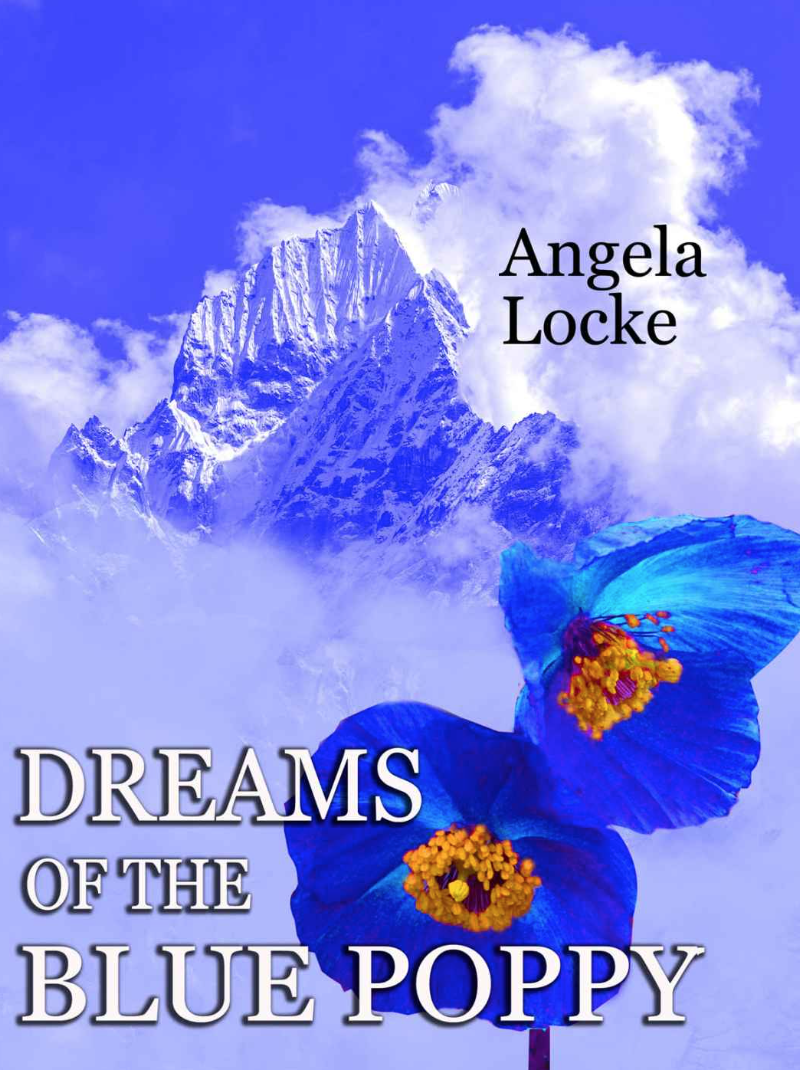
Our resident tutor Angela Locke’s Dreams of the Blue Poppy is here. Some of her other publications can be seen / purchased here.
‘Forbidden to walk because of his illness, Charles Fergusson is growing up a spoiled sickly child. He dreams of becoming a plant hunter, and of finding the fabled Blue Poppy which grew in his grandmother’s garden in Sikkim, but it seems that he will be trapped forever in the dark house in the Cumbrian fells …’
Suck down the nectar Let the sweetness register, hold it to your lips Like a dying man in the desert, Press a petal against your skin, Marvel at the silk soft summer strength of it. The pollen will stain your hands and make you sneeze, But that is what it does – it has a job to do. Remove the black shrivelled scorched pod firmly. It is full of tiny seeds – like eggs waiting to be born, Remove them, roughly. They are the threat. They must replace the snaking stem Clinging to the sun-blushed wall and the swaying pastel colours of the flowers. They are next year’s news.
Cumbria in Autumn is a veritable fount of inspiration for writers. I want to find time to write something about this vision beside the river down at Caldbeck this week.
This year’s festival will look at writing inspired by our relationship with the landscape. The festival will be launched by mountaineering legend Doug Scott.
Speakers appearing during the festival weekend include Eric Robson, Steve Matthews, Kim Moore, Robin Ashcroft, Tom Pickard, Josephine Dickinson, Juliet Barker, Catherine Anderson and Simon Yates.
There will be an appearance from the Lakeland Dialect Society and writing workshops will be led by Nick Pemberton and Grevel Lindop.
The C-Art Cumbrian Artist of the Year has returned to the Gallery at Rheged and I’ve just had a great morning there – noting the colours of Autumn’s own natural art as I cycled in.
In association with Cumbria Life, this year’s exhibition, says Rheged’s website
‘showcases an excellent cross section of Cumbrian visual and applied arts by Conrad Atkinson, Margaret Harrison, Maddi Nicholson and Paul Scott have been specially invited to exhibit this year. These artists are widely regarded as some of the most established and internationally renowned artists working in Cumbria today. Their work will join a cross section of artwork from the wider Cumbrian artistic community, selected from an open call by a group of young curators aged 16-24, guided by Eliza Bonham Carter, Head of the Royal Academy Schools, and Nick Rogers, Curator at the Lakeland Arts Trust. Alongside the exhibition, there will be a major new Rheged-commissioned sculpture trail, with three major new commissions which respond to the architecture of the building funded by Arts Council England.’
Look out for a flood-damaged piano that’s been inspirationally drawn into new musical and artistic life. And – for we writers – who might also do a bit of sketching here and there, there’s a lovely art shop including writing/sketching journals, watercolours, other arty bits and pieces and a bright little selection of books.
Definitely worth a visit and I’m glad that MW committee meetings are held there because I’ll be certain to tour the exhibition again.
Over the last eighteen years many members of Mungrisdale Writers have been enthusiastic participants in the residential writing retreats facilitated by our resident tutor Angela Locke. The brochures for the Retreats planned for 2017, in Ambleside and Iona, Scotland, are available here
The 2017 Bristol Short Story Prize is open to all published and unpublished writers. There is no geographical restriction on entry – the 2017 Bristol Short Story Prize is open to everyone, whether they are based in the UK or outside the UK. Entries can be made online or by post.






















 Mungrisdale Writers
